
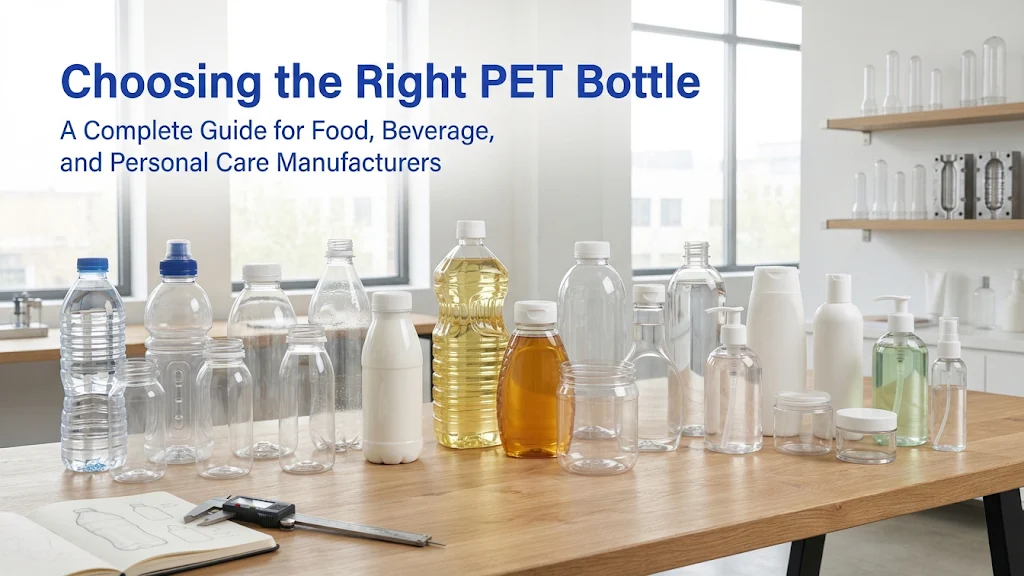
Choosing the Right PET Bottle: A Complete Guide for Food, Beverage, and Personal Care Manufacturers
Choosing the right PET bottle is an important decision for manufacturers operating in the food, beverage, and personal care industries. Packaging plays a much greater role than simply containing a product; it directly influences product protection, consumer convenience, manufacturing efficiency, and brand presentation.

A well-selected PET bottle should meet the technical requirements of the product while providing practical functionality and an attractive appearance.
From bottle shape and capacity to neck finish and closure compatibility, every packaging detail contributes to the overall performance of the final product.
At HANA PET, we understand that different industries require different packaging solutions. With extensive experience in PET packaging manufacturing since 1996, we provide a wide selection of bottle designs, capacities, and customized solutions to support diverse industrial applications.
Whether you are packaging beverages, food products, cosmetics, or personal care formulations, selecting the appropriate PET bottle requires careful consideration of several technical and commercial factors.
Understanding how to choose the right PET bottle can help manufacturers improve packaging performance, strengthen brand identity, and achieve greater efficiency throughout the production process.
Selecting the Ideal Bottle Shape, Size, and Capacity
Bottle shape, size, and capacity are among the first factors manufacturers should consider when developing a packaging strategy. These characteristics influence product storage, consumer handling, filling operations, transportation, and overall market positioning.
The ideal bottle design should accommodate the required product volume while providing convenient handling and compatibility with the intended application.
At HANA PET, we offer a variety of PET packaging options designed to meet different product and industry requirements. Our available capacities range from 100 ml to 1200 ml, allowing manufacturers to select suitable containers for different market segments.
Several factors should guide the selection process:
- Bottle Shape: The shape should reflect the product’s intended use, target audience, and dispensing requirements. Ergonomic designs can improve grip and make everyday handling more convenient.
- Bottle Capacity: The selected volume should correspond to consumer preferences, product consumption patterns, and the intended sales format.
- Bottle Dimensions: Height, width, and proportions should support efficient storage, transportation, labeling, and filling operations.
- Structural Stability: The bottle base and overall geometry should provide suitable stability during production, storage, and distribution.
- Brand Presentation: Distinctive shapes and proportions can help products stand out on retail shelves and reinforce brand recognition.
For example, beverage manufacturers may prioritize practical bottle shapes that are easy to hold and consume from, while personal care brands may prefer ergonomic designs that provide better control during dispensing.
Similarly, food manufacturers should consider bottle dimensions and openings that support convenient product access and storage.
Selecting the right combination of shape and capacity also allows brands to develop coordinated packaging ranges. A manufacturer can introduce different bottle sizes while maintaining a consistent visual identity across its product portfolio.
At HANA PET, our standard and customized PET packaging solutions help businesses find suitable bottle designs that combine functionality, manufacturing precision, and attractive presentation.
Understanding Neck Finishes and Closure Compatibility
The neck finish is one of the most important technical features of a PET bottle. It determines how the container connects with its closure and plays a major role in sealing performance, product protection, and dispensing functionality.
Choosing the correct neck finish is essential for ensuring that bottles work effectively with compatible caps, pumps, and other closure systems.
A mismatch between the bottle neck and closure can lead to leakage, poor sealing, filling difficulties, and unnecessary production interruptions.
At HANA PET, we recognize the importance of dimensional accuracy in PET bottle manufacturing. Our standard neck size options include 20 mm, 24 mm, and 28 mm, supporting different packaging applications and closure requirements.
Manufacturers should consider several important factors when selecting a neck finish:
- Neck Diameter: The opening diameter must match the specifications of the selected cap or closure system.
- Thread Specifications: Thread design, pitch, and dimensions should provide proper engagement between the bottle and closure.
- Sealing Performance: The neck finish should support reliable contact with the closure to help prevent leakage and protect the product.
- Closure Compatibility: Different products may require screw caps, dispensing caps, pumps, or specialized closures depending on their intended use.
- Filling-Line Requirements: Neck dimensions should be compatible with the equipment used for filling, capping, and automated packaging operations.
For example, beverage bottles commonly require closures designed for secure sealing and convenient opening. Personal care products, on the other hand, may require pump dispensers or flip-top caps that provide controlled product dispensing.
Food packaging applications may also require specific closure configurations depending on the product characteristics and storage requirements.
Another important consideration is consistency during mass production. Accurate neck dimensions help ensure that closures fit reliably across large production batches, reducing packaging defects and improving operational efficiency.
At HANA PET, our manufacturing approach focuses on dimensional precision and practical packaging compatibility, helping businesses select PET bottles that meet their closure and production requirements.
Matching PET Packaging to Different Product Requirements
Not all products have the same packaging requirements. Food, beverage, and personal care manufacturers must consider the physical characteristics of their products, their intended use, and the conditions under which they will be stored and distributed.
Selecting suitable PET packaging requires understanding how container design, material properties, and closure systems work together to support the product throughout its lifecycle.
At HANA PET, we provide PET packaging solutions for different industrial applications, helping manufacturers identify containers that match their specific product requirements.
Different industries may prioritize different packaging characteristics:
- Food Products: Food packaging should provide suitable product protection, convenient access, and compatibility with the intended storage and filling conditions. Bottle openings and closure systems should also reflect the product’s consistency and dispensing requirements.
- Beverages: Beverage containers should offer practical handling, suitable capacity, secure closure compatibility, and appropriate structural performance during filling, storage, and transportation.
- Personal Care Products: Shampoos, liquid soaps, and other personal care formulations may require ergonomic bottle designs, convenient dispensing systems, and packaging that supports everyday consumer use.
- Cosmetic Products: Cosmetic packaging often places additional emphasis on visual presentation, product accessibility, and compatibility with suitable dispensing closures.
Several product-related considerations should be evaluated before selecting a PET bottle:
Product Characteristics: Manufacturers should consider the product’s viscosity, sensitivity, and compatibility with the selected packaging material.
Storage Conditions: Temperature, light exposure, and storage duration may influence the packaging specifications required for a particular application.
Dispensing Requirements: The bottle opening and closure system should allow consumers to access and dispense the product conveniently.
Manufacturing Compatibility: Packaging dimensions and neck specifications should match the requirements of filling and capping equipment.
It is also important to recognize that not every PET bottle is suitable for every product. Manufacturers should evaluate material compatibility and conduct appropriate testing based on the intended application.
At HANA PET, our experience in PET packaging manufacturing helps businesses identify practical container options for different product categories while considering technical specifications and production requirements.
Balancing Product Protection, Functionality, and Brand Presentation
An effective PET bottle must achieve more than an attractive appearance. It should protect the product, provide convenient functionality, and communicate the brand’s identity throughout the consumer experience.
Balancing these elements requires a comprehensive approach to packaging design, where technical performance and visual presentation are considered together.
At HANA PET, we understand that successful packaging solutions must satisfy both industrial requirements and commercial objectives.
Several factors contribute to achieving this balance:
- Product Protection: Bottle material, wall thickness, closure compatibility, and structural design should provide appropriate protection for the intended product and application.
- Functional Convenience: Ergonomic proportions, suitable openings, and compatible dispensing systems can improve product accessibility and everyday usability.
- Visual Appeal: Bottle shape, transparency, surface characteristics, and label placement contribute to the overall appearance and brand presentation.
- Manufacturing Efficiency: Consistent dimensions and accurate neck specifications help support reliable filling, capping, and labeling operations.
- Transportation Performance: Proper bottle geometry and structural stability can help reduce packaging difficulties during storage and distribution.
Brand presentation is particularly important in competitive markets. Packaging is often one of the first elements consumers notice when comparing similar products.
A distinctive bottle shape, coordinated dimensions, and professionally designed labeling can help manufacturers create a recognizable product identity.
However, visual appeal should never come at the expense of technical performance. A bottle must remain suitable for its intended contents, filling process, storage conditions, and closure system.
For brands seeking more distinctive packaging, custom PET bottle development offers additional design flexibility. At HANA PET, our integrated engineering department supports the development of exclusive PET molds through 3D modeling and specialized manufacturing processes.
This approach allows businesses to explore customized bottle shapes and dimensions while considering the practical requirements of industrial production.
By combining functional engineering with thoughtful design, manufacturers can create PET packaging that protects their products and strengthens their market presence.
PET Bottle Selection Guide: Comparing Packaging Requirements
Choosing the right PET bottle involves evaluating several factors together. The following comparison highlights the main considerations manufacturers should review before selecting their packaging solutions.
| Selection Factor | Key Consideration | Packaging Objective | HANA PET Solution |
|---|---|---|---|
| Bottle Shape | Geometry, grip, and stability | Improve functionality and handling | Standard and custom bottle designs |
| Bottle Capacity | Product volume and target market | Meet different consumer requirements | Capacities from 100 ml to 1200 ml |
| Neck Finish | Diameter and thread specifications | Ensure closure compatibility | Standard neck sizes of 20 mm, 24 mm, and 28 mm |
| Product Compatibility | Product characteristics and application | Support suitable packaging performance | PET packaging for different industries |
| Closure System | Cap, pump, or dispensing requirements | Provide convenient access and sealing | Different compatible packaging configurations |
| Brand Presentation | Shape, proportions, and labeling | Strengthen product identity | Custom PET mold development |
| Production Requirements | Dimensional accuracy and equipment compatibility | Support efficient manufacturing | Precision-engineered PET containers |
A carefully planned selection process helps manufacturers avoid common packaging problems while ensuring that the chosen container meets both technical and commercial expectations.
By considering product characteristics, bottle dimensions, neck specifications, and visual requirements together, businesses can develop packaging solutions that support their long-term production and branding objectives.
Frequently Asked Questions (FAQ)
How do manufacturers choose the right PET bottle for their products?
Manufacturers should consider product characteristics, required capacity, bottle shape, storage conditions, neck finish, closure compatibility, and filling-line requirements. The ideal bottle should provide suitable product protection while supporting convenient handling and attractive presentation.
What PET bottle capacities does HANA PET offer?
HANA PET offers a variety of PET packaging capacities ranging from 100 ml to 1200 ml. These options allow manufacturers to select suitable containers for different food, beverage, and personal care applications.
Why is neck finish compatibility important in PET packaging?
Neck finish compatibility ensures that the selected cap or closure fits the bottle correctly. Proper compatibility helps support reliable sealing, reduce leakage risks, and maintain consistent performance during filling and packaging operations.
What neck sizes are available at HANA PET?
HANA PET offers standard neck sizes including 20 mm, 24 mm, and 28 mm. The appropriate option depends on the bottle design, closure specifications, and intended application.
Can the same PET bottle design be used for different products?
Not necessarily. Different products have different material compatibility, dispensing, storage, and protection requirements. Manufacturers should evaluate the intended application and conduct appropriate testing before using the same packaging design across different product categories.
Can HANA PET provide customized PET bottle designs?
Yes. HANA PET has an integrated engineering department capable of developing exclusive PET molds. The process includes 3D modeling, custom mold engineering, and production preparation to meet specific packaging and branding requirements.
Conclusion
Choosing the right PET bottle is a strategic decision that influences product protection, consumer convenience, manufacturing efficiency, and brand presentation.
Selecting the right PET bottle for food, beverage, and personal care products requires careful evaluation of bottle shape, capacity, neck finish, closure compatibility, and product-specific requirements. Bringing these elements together helps manufacturers develop packaging solutions that perform effectively throughout the product lifecycle.
At HANA PET, we combine decades of experience in PET packaging manufacturing with advanced production technologies, flexible capacity options, and specialized engineering capabilities.
From standard PET bottles ranging from 100 ml to 1200 ml to customized packaging designs developed through 3D modeling and exclusive mold engineering, we support manufacturers across different industries with practical packaging solutions.
Whether you are launching a new product, expanding your packaging range, or looking for a more distinctive bottle design, choosing the right PET packaging is an important step toward achieving your business goals.
Partner with HANA PET and discover PET packaging solutions that combine product protection, functional design, and brand presentation. Let’s find the right bottle for your product and your market.
 English
 Arabic