
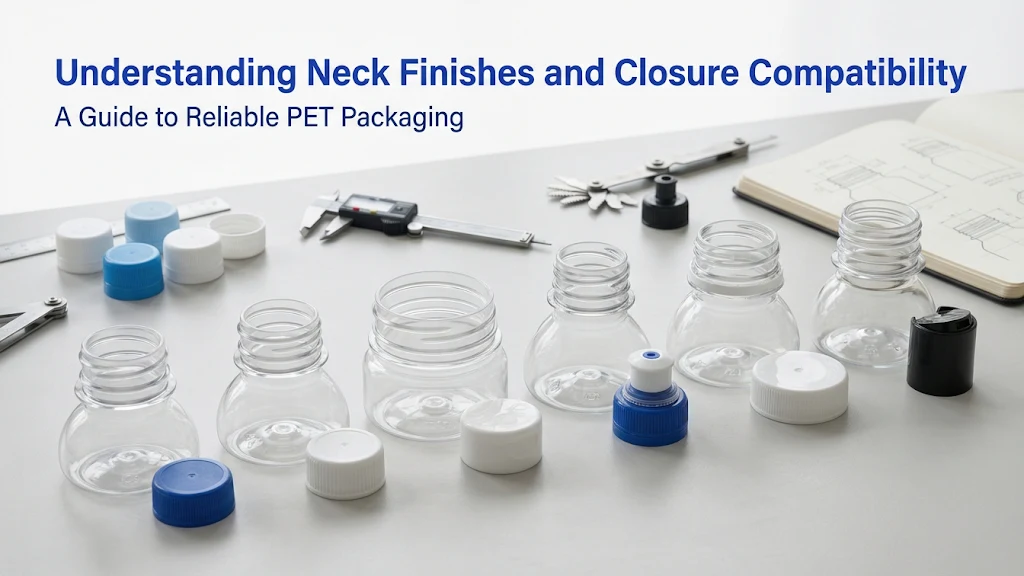
Understanding Neck Finishes and Closure Compatibility: A Guide to Reliable PET Packaging
In PET packaging manufacturing, choosing the right bottle is only part of the process.
The neck finish and closure system are equally important because they determine how securely a container can be sealed, how easily it can be opened, and how efficiently it performs during filling, storage, and transportation.
Understanding neck finishes and closure compatibility is essential for manufacturers seeking reliable packaging solutions that prevent leakage, maintain product integrity, and support automated production lines.
Even a high-quality PET bottle can experience performance problems if its neck dimensions are not properly matched with the selected cap or closure.
At HANA PET, we understand the importance of precision in every packaging component.
With extensive experience in PET packaging manufacturing since 1996, we focus on delivering containers designed to meet different industrial requirements, combining manufacturing accuracy with practical functionality.
Whether you manufacture beverages, food products, cosmetics, or personal care items, selecting the right neck finish and closure combination is an important step toward achieving reliable packaging performance.
Exploring Standard PET Bottle Neck Finishes and Thread Specifications
The neck finish is the upper section of a PET bottle where the closure is attached. It includes specific dimensions, threads, sealing surfaces, and other structural features that determine which caps can be used with the container.
Standard PET bottle neck finishes are designed to provide consistent dimensions and compatibility with suitable closure systems.
Their specifications may include neck diameter, thread design, height, and sealing surface characteristics.
Selecting the correct neck finish is essential for achieving a secure connection between the bottle and its closure.
Important considerations include:
- Neck Diameter: Determines the nominal size of the compatible closure and must match the cap specifications.
- Thread Design: Defines how the cap engages with the bottle and how securely it can be tightened.
- Neck Height: Influences closure positioning and compatibility with filling and capping equipment.
- Sealing Surface: Provides the contact area required to create an effective seal and minimize leakage risks.
At HANA PET, packaging selection considers the technical requirements of different applications. Choosing an appropriate neck finish helps manufacturers maintain consistent packaging performance and simplify the integration of bottles with suitable closures.
Matching Caps and Closures to Different Bottle Neck Designs
A bottle and its closure must function as a coordinated packaging system.
Selecting a cap based only on its nominal diameter is not sufficient; the thread profile, neck dimensions, sealing method, and intended application must also be considered.
Different products require different closure solutions depending on their characteristics and dispensing requirements.
Common closure options include:
- Screw Caps: Provide a practical closing mechanism for many beverage, food, and personal care containers.
- Flip-Top Closures: Allow convenient opening and dispensing, making them suitable for shampoos, liquid soaps, and similar products.
- Dispensing Pumps: Commonly used for lotions, liquid skincare products, and personal care formulations.
- Tamper-Evident Closures: Help indicate whether a container has been opened before reaching the consumer.
The correct closure must match the bottle’s neck finish and sealing requirements. An incompatible combination may result in loose caps, damaged threads, or inadequate sealing.
At HANA PET, selecting suitable packaging specifications is an important part of developing reliable PET container solutions that meet different product and manufacturing requirements.
Ensuring Leak Prevention Through Proper Sealing and Closure Selection
Leakage is one of the most common packaging challenges faced by manufacturers. It can lead to product waste, damaged shipments, increased operational costs, and negative customer experiences.
Proper sealing and closure selection play a critical role in protecting product integrity throughout storage, transportation, and everyday use.
A reliable sealing system depends on several factors:
- Accurate Neck Dimensions: Consistent dimensions help ensure that the selected closure fits correctly.
- Compatible Thread Specifications: Proper thread engagement supports secure cap application and reduces the risk of loosening.
- Appropriate Sealing Design: The closure’s liner, sealing surface, or internal sealing feature must suit the bottle and product requirements.
- Controlled Capping Torque: Applying the correct tightening force helps achieve reliable sealing without damaging the threads or closure.
- Product Compatibility: The closure materials and sealing components should be suitable for the packaged formulation.
Leak prevention is particularly important for liquid products such as beverages, shampoos, lotions, and cleaning formulations.
At HANA PET, we recognize that packaging reliability depends on the compatibility of all components.
Evaluating the bottle and closure together helps manufacturers reduce potential sealing problems and improve overall packaging performance.
The Importance of Neck Finish Precision in Automated Filling Lines
Modern packaging facilities rely on automated filling and capping equipment to maintain production speed, consistency, and efficiency. In these environments, even small variations in bottle neck dimensions can create operational challenges.
Neck finish precision is therefore essential for ensuring reliable integration between PET containers and automated production systems.
Accurate neck dimensions help support:
- Consistent Cap Application: Uniform neck specifications allow capping equipment to apply closures more reliably.
- Reduced Production Interruptions: Proper dimensional control helps minimize problems caused by incompatible bottles and closures.
- Improved Sealing Performance: Consistent neck geometry supports repeatable sealing results.
- Higher Production Efficiency: Packaging designed for equipment compatibility helps maintain smoother manufacturing workflows.
At HANA PET, manufacturing precision and quality control are important elements of PET packaging production.
Our experience and production technologies support the development of containers designed to meet the dimensional and functional requirements of industrial applications.
By considering neck finish specifications during packaging selection, manufacturers can improve production compatibility and reduce avoidable operational issues.
PET Bottle Neck Finishes and Closure Compatibility: Key Considerations
| Packaging Component | Important Specification | Main Purpose |
|---|---|---|
| Neck Diameter | Nominal neck dimensions | Ensures suitable closure sizing |
| Thread Design | Thread profile and dimensions | Provides secure cap engagement |
| Sealing Surface | Contact and sealing geometry | Helps prevent leakage |
| Closure Type | Screw cap, flip-top, or pump | Supports the intended dispensing method |
| Dimensional Precision | Consistent manufacturing tolerances | Improves automated filling and capping compatibility |
Frequently Asked Questions (FAQ)
What is a PET bottle neck finish?
A PET bottle neck finish is the upper section of the container that connects with the cap or closure. It includes specific dimensions and thread characteristics that determine closure compatibility and sealing performance.
Why is neck finish compatibility important?
Proper compatibility ensures that the selected closure fits correctly, engages with the bottle threads, and provides an appropriate seal. It also helps prevent leakage and supports reliable capping operations.
Can different closure types be used with the same PET bottle?
Not necessarily. Screw caps, flip-top closures, and dispensing pumps require compatible neck specifications. The bottle’s dimensions and closure design must be evaluated before selecting the final combination.
How does neck finish precision affect automated production?
Accurate neck dimensions help ensure consistent cap application and reliable interaction with automated filling and capping equipment. This reduces the likelihood of production interruptions and sealing problems.
What should manufacturers consider when selecting a PET bottle closure?
Manufacturers should evaluate neck diameter, thread specifications, sealing requirements, product characteristics, dispensing needs, and compatibility with their production equipment.
Conclusion
Selecting the right neck finish and closure combination is essential for achieving reliable PET packaging performance. From secure sealing and leakage prevention to automated production compatibility, every technical detail contributes to the quality of the final package.
Understanding neck finishes and closure compatibility allows manufacturers to make informed packaging decisions, protect their products, and improve production efficiency.
At HANA PET, we combine decades of PET packaging experience with manufacturing expertise and a commitment to quality. Our goal is to support businesses with packaging solutions that meet their functional, technical, and industrial requirements.
Whether you are developing a new product or optimizing an existing packaging system, choosing the right PET bottle specifications is an important step toward reliable production.
Partner with HANA PET and discover PET packaging solutions designed for precision, performance, and dependable quality.
 English
 Arabic